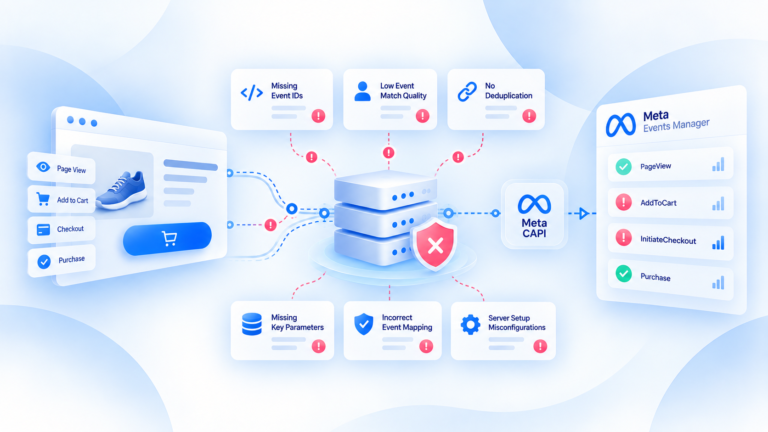
A conversion API integration should be treated as an event-delivery system, not a checkbox that says “server-side tracking is installed.”
Before trusting it, an ecommerce team should define the conversion events that matter, validate values and identifiers, plan browser/server deduplication, test the full delivery path against real orders, and monitor the integration after launch. If those controls are missing, a technically successful API connection can still produce incomplete, duplicated, or misleading conversion data.
Define the conversion events that actually matter
Start with the business events you genuinely need for measurement.
Do not begin by sending every possible event simply because the source can produce it.
For most ecommerce teams, the priority is to identify the events that matter to revenue and decision-making, then confirm that each one is supported by the intended source and destination workflow.
That usually means asking:
- Which events represent meaningful customer actions?
- Which events are used for reporting or optimization?
- Which events already exist in the browser path?
- Which events can be created reliably from the server-side source?
- Which source should be authoritative for each event?
The important part is definition.
A purchase event should mean the same business action every time it is created.
If one implementation defines a purchase at order confirmation while another creates it earlier in checkout, the integration already has a measurement problem before the API call is made.
Keep the initial scope deliberate.
It is easier to validate a small set of business-critical events properly than to launch a large event catalog that nobody can reconcile later.
Validate event values and customer identifiers
A delivered event is not automatically a useful event.
Before sending production traffic, inspect the fields that make the conversion meaningful and traceable.
Purchase value
For purchase events, compare the event value with the completed source transaction.
The value should represent the intended business amount according to the implementation definition.
Do not assume a value is correct because the request was accepted.
Common problems include values captured before an order changed, incorrect mapping, missing values, or different values between browser and server representations.
The store or other approved source of truth should remain the reference during validation.
Currency
Currency should be checked alongside the value.
A correct number with the wrong currency is still incorrect conversion data.
If the business sells in more than one currency, the integration needs a clear rule for how the currency field is created and passed.
Do not hard-code one currency unless that reflects the actual source behavior.
Event ID
A stable event or transaction identity is important when the same business conversion may be represented through more than one path.
The exact destination-specific matching field must be verified against that platform's current requirements.
The broader rule is simple:
one business event should keep a consistent identity wherever overlapping implementations need to recognize it as the same transaction.
An ID field that exists but changes independently between browser and server paths does not solve the coordination problem.
Available identifiers
Review the identifiers the destination requires or can use within the verified implementation and applicable data rules.
Only send identifiers that are permitted, relevant, and actually available from the source.
Do not invent missing data, and do not treat “more identifiers” as automatically better.
The goal is a valid, controlled event payload that can be traced back to the source transaction.
Plan browser and server event deduplication
If browser and server tracking can both send the same conversion, deduplication needs to be designed before launch.
Do not wait until the platform reports inflated purchases.
Map the overlap first.
For each conversion event, document:
- whether the browser sends it;
- whether the server sends it;
- whether both represent the same business transaction;
- which identifier connects the two representations;
- what happens if one path is delayed or unavailable.
The architecture should make one real purchase understandable across the full measurement path.
A browser event and server event can both be valid.
The problem begins when they behave like unrelated conversions.
This is also the point to remove duplicate implementations.
A plugin, legacy tag, custom script, tag manager configuration, and backend integration can sometimes create more event paths than the team realizes.
Deduplication logic should not become a way to hide an unnecessarily duplicated architecture.
First understand how many implementations create the event.
Then coordinate the paths that are intentionally meant to overlap.
Test delivery before trusting platform reports
Testing should start from a real or controlled source transaction, not from a platform dashboard total.
Follow the event end to end.
A useful validation sequence is:
source transaction → event creation → server processing → outgoing delivery → destination receipt → source-of-truth reconciliation
At each step, confirm the details still make sense.
Check:
- event name;
- order or event ID;
- value;
- currency;
- relevant identifiers;
- browser/server overlap;
- outgoing delivery status;
- destination outcome.
A successful request only proves that one part of the path worked.
It does not prove the source data was correct.
It does not prove the destination processed the event as intended.
And it does not prove the event was not duplicated elsewhere.
If the source transaction exists but the event was never created, fix the source.
If the event exists but no request leaves the server-side workflow, inspect processing and routing.
If delivery fails, investigate the destination-specific implementation.
If the event is received but counts still do not reconcile, inspect deduplication, attribution, and reporting separately rather than assuming transport is the problem.
Do not move from testing to “trusted” simply because events appear in the platform.
Trust should come from reconciliation.
Monitor the integration after launch
A Conversion API integration is not finished when the first production event is accepted.
It needs ongoing monitoring because the surrounding systems change.
Store logic changes.
Tags change.
Destination requirements change.
New scripts or plugins can introduce duplicate events.
Identifiers can disappear after a deployment.
Values can drift because a field mapping changed.
The minimum useful monitoring should look for:
- missing conversion events;
- duplicate events;
- delivery failures;
- unexpected changes in event volume;
- incorrect values or currency;
- missing or inconsistent event IDs;
- browser/server discrepancies;
- reconciliation gaps against source transactions.
Monitoring should help answer a simple question:
Can we identify where the event path changed before unreliable data becomes normal?
If the team notices a drop in delivered purchases, it should be able to separate source failure from processing failure and destination failure.
If duplicates increase, it should be possible to trace which implementations created them.
If platform numbers move away from store transactions, the team should know whether the cause is measurement or normal attribution/reporting differences.
That operational visibility is part of the integration.
It should not be added only after a major discrepancy appears.
Conversion API integration readiness checklist
Before considering the setup ready, make sure you can answer yes to these questions:
- Are the business-critical conversion events clearly defined?
- Is each event supported by the intended source and destination scope?
- Do purchase values reconcile with source transactions?
- Is currency handled correctly?
- Are event or transaction identifiers stable and traceable?
- Are permitted destination-relevant identifiers mapped intentionally?
- Is browser/server overlap documented?
- Is deduplication planned for overlapping events?
- Have duplicate or legacy implementations been identified?
- Can you trace an event from source to server processing?
- Can you verify outgoing delivery?
- Can you inspect the destination outcome?
- Have you reconciled test events with source-of-truth transactions?
- Is there a monitoring process for missing events, duplicates, delivery errors, values, and identifiers?
If several of these answers are unclear, the next step should not be “send more events.”
The next step is to identify which part of the current measurement path is not yet trustworthy.
A Tracking Health Audit is appropriate when the team cannot confidently isolate whether the problem is in the source event, browser/server coordination, event quality, delivery, or destination reconciliation.
The objective is not to prescribe a migration before the evidence is clear.
It is to verify the event path first, then make the smallest appropriate implementation decision.
Related guides
Frequently Asked Questions
Which events should be defined first?
The business-critical events actually needed for measurement, then verified against supported source/destination scope.
Which values and identifiers should be validated?
Event IDs, monetary values/currency and destination-relevant permitted identifiers.
How should deduplication be planned?
Define overlapping browser/server events and how one business event will carry consistent identity.
What should be tested before trusting platform numbers?
Source transaction, event fields, delivery status, destination receipt and source-of-truth reconciliation.
What should be monitored after launch?
Missing/duplicate events, delivery errors, values, identifiers and reconciliation.