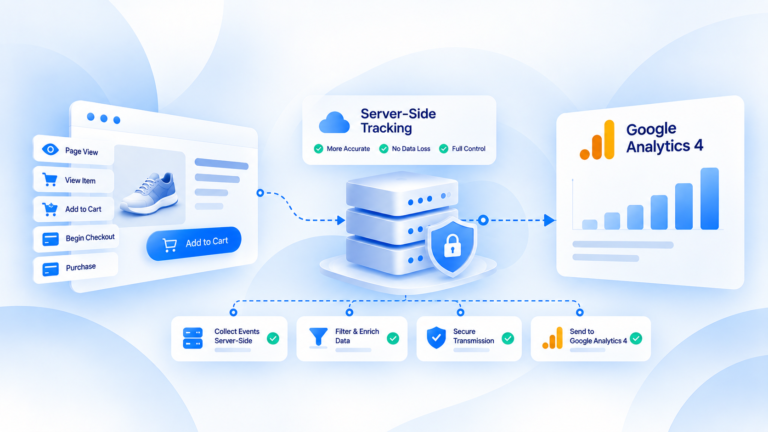
Server-side tracking for ecommerce can improve how purchase and conversion data is collected, checked, deduplicated, and delivered across a tracking stack.
The important limitation is just as clear: it cannot recover an event that never existed at the source, fix a bad campaign, or force your store and ad platforms to report identical revenue. Server-side tracking is useful when the problem is in the measurement path. It is not a universal fix for every marketing or attribution problem.
The ecommerce tracking problems server-side architecture can address
Ecommerce tracking problems usually show up after the store already has real orders.
The store says one thing. The ad platform says another. Some purchases appear to be missing. Others appear twice. A value is wrong. A server event never reaches its destination. Or the team has no clear way to tell where the event failed.
A server-side architecture can help because it creates a controlled layer between the source event and the systems that consume it.
That layer can be used to validate the event, handle identifiers, apply deduplication rules, prepare destination-specific delivery, and monitor what happens along the way.
The benefit is not simply that the event is "server-side."
The benefit is that the business has a clearer place to control and inspect the event path.
Missing purchase signals
If part of the loss happens because conversion delivery depends too heavily on the browser, a server-side path can reduce that dependency.
That matters when scripts fail, browser behavior changes, requests are blocked, or page-level implementation becomes fragile.
But there is a hard boundary.
If the store never creates a purchase event, or the backend never exposes the purchase data, the server has nothing reliable to process.
Server-side tracking can make delivery more dependable. It cannot invent a transaction that never entered the measurement system.
Browser limitations
Browser-based tracking runs in an environment the business does not fully control.
A tag can fail. An extension can block a request. A user can leave the page before a request completes. Different browsers can behave differently.
Moving part of the event flow server-side can reduce how much the measurement stack depends on those conditions.
That does not mean the browser becomes irrelevant. In many implementations, browser and server paths still work together. The point is to reduce unnecessary dependence on a single fragile path.
Event delivery consistency
Once an event reaches a controlled server layer, the team has a better place to apply the same rules before delivery.
For a purchase event, that may include checking value, currency, event ID, available identifiers, and destination requirements.
The result can be a cleaner and more consistent delivery process.
It is still possible to send bad data consistently. That is why validation matters as much as transport.
Problems server-side tracking cannot solve by itself
Server-side tracking is measurement infrastructure.
It does not repair the business itself.
If people are not buying because the offer is weak, a server layer will not fix the offer.
If the ad creative is poor, better event delivery will not make the creative persuasive.
If targeting is wrong, tracking will not correct the audience strategy.
If checkout is confusing or broken, server-side tracking will not remove that friction.
This distinction matters because tracking problems and marketing problems can look similar from a distance.
A campaign may appear to have fewer conversions because events are missing.
Or it may actually have fewer conversions because fewer customers bought.
Those are very different problems.
The same applies to attribution.
Server-side tracking can improve the quality and consistency of the events that platforms receive. It cannot force every platform to interpret those events in the same way.
The system should be judged on whether it improves the reliability of the event path, not whether every dashboard suddenly agrees.
Why store revenue and ad-platform numbers can still differ
Better tracking does not mean identical reporting.
Your store records actual transactions.
Advertising platforms report conversions according to their own attribution and reporting logic.
That means a single order can be treated differently across systems even when the underlying event was delivered correctly.
Attribution
An ad platform may credit a conversion to an interaction that the store does not record as an attribution event at all.
The store knows an order happened.
The ad platform tries to decide which ad interaction deserves credit.
Those are related questions, but they are not the same question.
This is why a revenue difference does not automatically prove the tracking implementation is broken.
Reporting windows
Different systems can also use different time windows, processing times, or reporting cutoffs.
A purchase can exist in the store immediately while another platform processes or attributes it differently.
That difference should be explainable. It does not need to be zero.
Duplicate and missing events
Some gaps are not attribution differences.
If a purchase event is genuinely missing, the platform may receive less conversion value than the store recorded.
If the same purchase is sent more than once without effective deduplication, the platform may receive too much.
The practical job is to separate those tracking errors from normal reporting differences.
That starts with the source transaction, not with the dashboard.
What a reliable ecommerce tracking setup needs beyond event delivery
Event delivery is only one part of a dependable tracking stack.
A request can arrive successfully and still contain the wrong information.
A purchase event can be delivered with the wrong value.
The currency can be incorrect.
An event ID can be missing or inconsistent.
The same order can be represented twice.
That is why a reliable setup needs more than a transport path.
It needs:
- a trustworthy source event;
- clear event definitions;
- correct value and currency;
- consistent identifiers;
- deduplication rules when paths overlap;
- destination-specific validation;
- monitoring for delivery failures;
- reconciliation with source-of-truth orders.
The goal is not to collect the maximum number of events.
The goal is to make the important events dependable enough that teams can understand what happened and trace where a failure occurred.
A strong event pipeline should make problems visible.
If a purchase disappears, the team should be able to ask: did the source create it, did the server process it, did delivery succeed, and did the destination accept it?
That is a more useful question than simply asking whether "server-side tracking is installed."
How to diagnose your current ecommerce tracking setup
Before upgrading anything, start with the transactions you trust.
Take a sample of real completed orders from the store and follow the event path.
For each order, check whether the expected purchase event exists.
Then ask:
- Is the value correct?
- Is the currency correct?
- Is there a stable event or order identifier?
- Is the event represented more than once?
- Do browser and server paths refer to the same business transaction?
- Did the event leave the tracking infrastructure?
- Did the intended destination receive it?
This process helps separate architecture problems from reporting differences.
If the source event is wrong, fix the source.
If the event is duplicated, fix the coordination.
If delivery fails, investigate the delivery path.
If the event path is healthy but the dashboards still disagree, attribution or reporting logic may explain the difference.
Server-side tracking is worth evaluating when the event path itself is unreliable and the business needs more control over validation, deduplication, routing, and delivery.
It should not be adopted simply because it is considered more advanced.
The right architecture is the one that makes the business's conversion data easier to trace and trust.
Related guides
Frequently Asked Questions
Which ecommerce tracking problems can server-side tracking improve?
It can improve control over collection, validation, identifiers, deduplication and delivery.
Can it recover every missing purchase event?
No; it cannot recover an event never created or captured at the source.
Why can store and ad-platform revenue still differ?
Better tracking does not remove attribution-window, model or reporting-rule differences.
What else does the stack need besides event delivery?
Reliable source events, values/currency, identifiers, deduplication, monitoring and source-of-truth reconciliation.
How do you know the store needs a server-side upgrade?
Diagnose source orders versus event delivery first; persistent unexplained loss or duplication is a stronger signal than trend adoption.