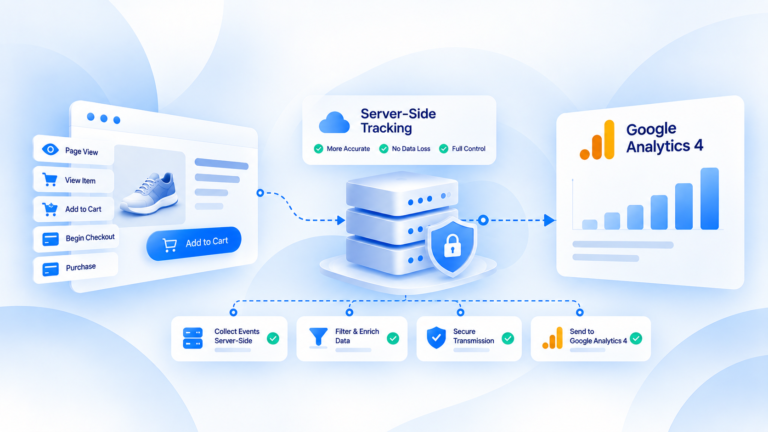
Managed server-side tracking vs DIY server-side GTM is really a decision about who owns the setup, monitoring, debugging, and ongoing maintenance.
The short answer: DIY can make sense when your team has the technical capacity, wants deeper control, and is prepared to operate the stack continuously. A managed approach shifts more of the event logic, validation, deduplication, monitoring, and troubleshooting into an ongoing service. Neither option is automatically better. The better choice is the one your team can keep reliable after launch.
What a DIY server-side GTM setup actually requires
A DIY setup is more than getting a server container running.
The tracking system still needs to work as a complete event path. Someone has to understand where the event comes from, how it should be processed, what identifiers matter, how duplicate events are handled, which destinations should receive the event, and what to do when something stops working.
That ownership stays with your team.
For some companies, that is exactly what they want. They have engineers or tracking specialists who prefer direct control and can maintain the setup as the site, data model, and destination requirements change.
For others, the infrastructure itself is not the hard part. The operational work around it is.
Infrastructure
A DIY team owns the server-side environment and the decisions around how it is operated.
That includes keeping the infrastructure available enough for the tracking flow it supports and making sure changes to the environment do not silently break event delivery.
The repo does not define one universal infrastructure design, so the practical requirement is ownership rather than a specific hosting recipe.
Tag and event configuration
The team also owns the event logic.
That means deciding how events are named, which fields are expected, how values and currency are handled, how identifiers are passed, and how browser and server paths are coordinated.
A working server container with poor event rules is still a poor tracking setup.
Monitoring
A DIY setup needs a way to notice when the event path stops behaving as expected.
If purchase events suddenly drop, values change, duplicates appear, or a destination stops receiving events, someone needs to detect the issue and investigate it.
Without monitoring, a technically valid implementation can stay broken longer than the business realizes.
Maintenance
The setup changes over time.
Websites change. Event definitions change. Destination requirements change. New tracking logic gets added. Old logic needs to be removed.
A DIY approach means your team owns those updates, along with the regression risk that comes with them.
That ongoing responsibility is the part teams often underestimate when they compare options only by initial setup effort.
What changes with managed server-side tracking
A managed service does not remove the need for a sound tracking architecture.
What changes is who carries more of the operational responsibility.
Instead of treating the project as "set up the server and hand it over," a managed model includes ongoing work around the event path itself.
Within the verified scope, that can include event handling, validation, deduplication controls, identifier quality, monitored delivery, and troubleshooting.
That matters because many tracking failures are not infrastructure failures.
The server can be online while the data is still wrong.
A purchase value can be incorrect.
An event ID can disappear.
The same order can be sent through two paths without proper coordination.
A destination can stop receiving an event even though everything upstream appears healthy.
Managed tracking is useful when the business wants someone to own that operating layer, not just the hosting layer.
It does not mean the business gives up every form of control. It means the division of responsibility changes.
The exact scope still needs to be verified. A managed service should never be treated as a blank promise that every source, destination, or workflow is automatically covered.
Cost is more than hosting
The easiest comparison is to look at infrastructure cost and stop there.
That is incomplete.
The real cost of a tracking stack also includes the people and time required to keep it dependable.
A low infrastructure bill can still sit on top of an expensive operating model if engineers repeatedly need to investigate missing events, repair custom logic, or update destination-specific implementations.
The repo does not support a universal numeric comparison between DIY and managed tracking, so the right way to compare cost is to look at the work each option creates.
Engineering time
DIY work competes with other engineering priorities.
Every tracking change, incident, debugging session, or migration uses time that could have been spent elsewhere.
That may be a perfectly reasonable trade if tracking infrastructure is strategically important to the team and the technical ownership is deliberate.
It becomes a problem when tracking is "owned by engineering" in theory but nobody has enough time to maintain it well.
Monitoring
Someone has to watch the system.
If the team cannot quickly see that purchase delivery has dropped or duplicates have increased, the cost is not only the time spent debugging later. It is also the period during which marketing decisions may be made using unreliable data.
Monitoring is part of operating the system, not an optional extra after implementation.
Debugging
Tracking failures often cross multiple layers.
The source event may be wrong.
The browser path may differ from the server path.
Deduplication may fail.
A destination may reject or fail to receive the event.
Finding the cause requires time and context.
In a DIY model, that troubleshooting responsibility stays inside the company.
Upgrades and changes
Tracking is not static.
New destination requirements, site changes, consent changes, data-model updates, and new event needs can all affect the implementation.
The question is not whether changes will happen.
The question is who is responsible for making them safely and verifying that existing measurement still works afterward.
Control, ownership, and observability
DIY usually offers the clearest form of direct technical ownership.
Your team controls the infrastructure, configuration, event rules, and change process.
That can be valuable when the business needs deep customization or has a strong internal data/tracking function.
But ownership has two sides.
You own the flexibility.
You also own the failure.
If an event disappears at 2 a.m., if a deployment breaks a purchase tag, or if a destination-specific change causes a regression, your team is responsible for finding and fixing it.
Managed tracking shifts some of that operational burden to the service provider.
The trade-off is that you need clear boundaries around what is managed, what remains under your control, and what evidence you can see when something goes wrong.
That is where observability matters.
Whether the system is DIY or managed, the business should be able to answer practical questions:
- Was the event created?
- Was it processed?
- Was it deduplicated correctly?
- Was it sent?
- Did the intended destination receive it?
- If something failed, where did it fail?
If neither model can give you those answers, the problem is not really DIY versus managed.
The problem is that the tracking stack is not observable enough.
A decision framework for DIY vs managed tracking
Do not choose based on which option sounds more technical.
Choose based on the operating model your team can sustain.
DIY is a stronger fit when:
- you already have the technical capacity to own the stack;
- deep customization matters;
- direct infrastructure and event-logic control is important;
- someone is clearly responsible for monitoring and debugging;
- your team is willing to maintain the implementation continuously.
Managed tracking is a stronger fit when:
- the business wants reliable event infrastructure without making internal engineering the default support desk;
- ongoing monitoring and troubleshooting matter as much as initial setup;
- tracking problems repeatedly consume developer time;
- the team wants operational help with validation, deduplication, identifiers, and delivery within a verified scope;
- the cost of internal maintenance is becoming harder to justify.
There is also a third possibility: the architecture may not need to change yet.
If the actual problem has not been diagnosed, choosing DIY or managed first can solve the wrong problem.
A broken source event stays broken in either model.
A duplicate purchase caused by two uncoordinated implementations still needs a clear root cause.
Before making a larger architecture decision, reconcile real source transactions with the event path and identify what is actually failing.
That gives you a better question than "Should we buy managed tracking?"
The better question is: Which operating model gives us the control, reliability, and maintenance burden we can realistically support?
If the answer is your internal team, DIY may be the right choice.
If the answer is a dedicated managed layer with clear scope and accountability, a managed approach may fit better.
And if you cannot yet explain where the current tracking breaks, diagnose that first.
Related guides
Frequently Asked Questions
What must a DIY team maintain?
Infrastructure, configuration, event rules, monitoring, debugging, upgrades and destination changes.
How does managed tracking differ from hosting?
Hosting supplies infrastructure; managed tracking also covers event logic, validation, deduplication, monitoring and troubleshooting.
What hidden DIY costs matter?
Engineering time, maintenance, observability, debugging and operational ownership; there is no universal numeric cost model that applies to every implementation.
When is infrastructure ownership useful?
When the team has technical capacity, deep customization needs and willingness to operate the stack continuously.
What should you compare before choosing DIY or managed?
Effort, control, ownership, monitoring, debugging, destination needs and maintenance.