
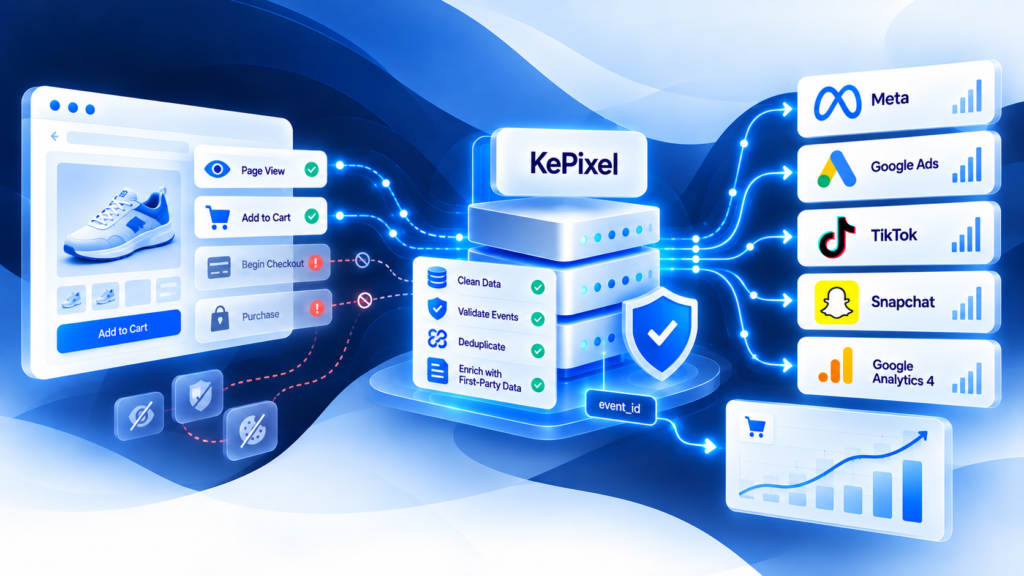
Why ecommerce brands need server-side tracking is best answered with a decision framework, not a blanket rule: a brand needs another measurement layer only when the current event path is unreliable, difficult to diagnose, or too fragmented for the decisions the team makes.
Server-side tracking can add control over validation, routing, duplicate handling, and delivery monitoring. It cannot repair a weak offer, create a Purchase that never happened, or make every platform report the same revenue.
The business case starts with measurement risk
Ecommerce teams depend on a small number of high-value events: Purchase, checkout progress, leads, subscriptions, and sometimes refunds.
When those events are missing or duplicated, the impact goes beyond a dashboard. Teams can make budget, creative, and bidding decisions using incomplete signals.
The question is whether the current tracking stack creates enough risk to justify another operational layer.
Signs the current setup deserves investigation
Real orders are missing from destination event logs
If the store shows completed orders but a platform repeatedly never receives the expected Purchase, trace the collection and delivery path.
One order is counted more than once
Multiple plugins, native integrations, browser tags, and server workflows can overlap. Duplicate Purchase is an ownership problem before it is a tooling problem.
The team cannot explain store-vs-platform gaps
Some differences are normal attribution or reporting differences. Others are missing events, wrong values, or duplicates. A mature measurement stack should make those categories distinguishable.
Changes repeatedly break tracking
Theme releases, checkout changes, consent tooling, payment methods, GTM changes, and app updates can all alter the event path. A controlled architecture becomes more valuable when regression risk is high.
Several destinations need one event definition
When every platform has its own independently implemented Purchase logic, the business can end up with different definitions of the same order. A canonical event model can reduce that drift.
What a server-side layer can improve
A controlled server layer can provide a place to:
- validate incoming events;
- normalize business fields;
- coordinate event identities;
- route to selected destinations;
- log delivery outcomes;
- control retries;
- monitor failures;
- keep destination mapping separate from business truth.
These are operational advantages. Their value depends on whether the business actually needs them.
What it cannot solve
Server-side tracking does not fix:
- poor campaign strategy;
- low conversion rate caused by the offer or checkout experience;
- bad source events;
- undefined revenue rules;
- consent obligations;
- platform attribution differences;
- every form of browser signal loss;
- a backend that does not expose reliable business events.
A new architecture can make a bad event easier to send consistently. That is not the same as making the event correct.
When native integrations may be enough
Do not add infrastructure just because server-side tracking is considered advanced.
A simpler setup may be enough when:
- critical events are reliable;
- duplicates are controlled;
- store-vs-platform differences are explainable;
- native integrations meet the business requirement;
- the team does not need custom routing or central diagnostics;
- maintenance cost would exceed the expected measurement benefit.
This is especially important for smaller stores where operational simplicity has real value.
A decision checklist for ecommerce teams
Before adopting another layer, answer:
- What is the exact tracking problem?
- Which orders or leads prove that problem exists?
- Who sends Purchase today?
- Which system is business truth?
- Is the problem collection, duplicate ownership, mapping, identity, delivery, or attribution?
- Which capabilities are missing from the current setup?
- Who will own monitoring and maintenance?
- What is the rollback plan if the new path fails?
If those questions are unanswered, start with diagnosis rather than implementation.
How this article differs from the technical ecommerce guide
This page answers the business decision: when does an ecommerce brand have enough measurement pain or operational complexity to justify evaluating server-side tracking?
A separate technical guide can explain how a server-side ecommerce event flow is built and validated. Keeping those intents separate is important because a buyer deciding whether to invest in architecture has a different question from an implementer debugging event transport.
Diagnostics that answer the business-case question
Use the ecommerce conversion tracking checklist to classify a real discrepancy before changing the stack.
Use What Is Server-Side Tracking? for the underlying architecture.
Decide whether to diagnose before rebuilding the stack
A Tracking Health Audit is the current verified diagnostic offer when a team needs to identify whether the problem is collection, event ownership, duplicate delivery, identifiers, routing, or reporting.
Request a Tracking Health Audit before committing to a larger implementation. Specific source and destination availability is verified separately.
Frequently Asked Questions
Does every ecommerce brand need server-side tracking?
No. A brand should add another layer only when it solves a defined measurement or operational problem.
What is the strongest reason to investigate it?
Persistent missing or duplicate business-critical events, combined with an inability to diagnose the current path, is a stronger reason than simply following an industry trend.
Will server-side tracking make store and ad-platform revenue match exactly?
No. It can improve event control and delivery, but attribution and reporting rules can still create legitimate differences.
Can native integrations be enough?
Yes. If critical events are reliable and the business does not need centralized routing or diagnostics, a simpler architecture may be the better choice.
What should I do before changing the stack?
Map current event ownership and trace real orders through the measurement path so the implementation is tied to a proven problem.