
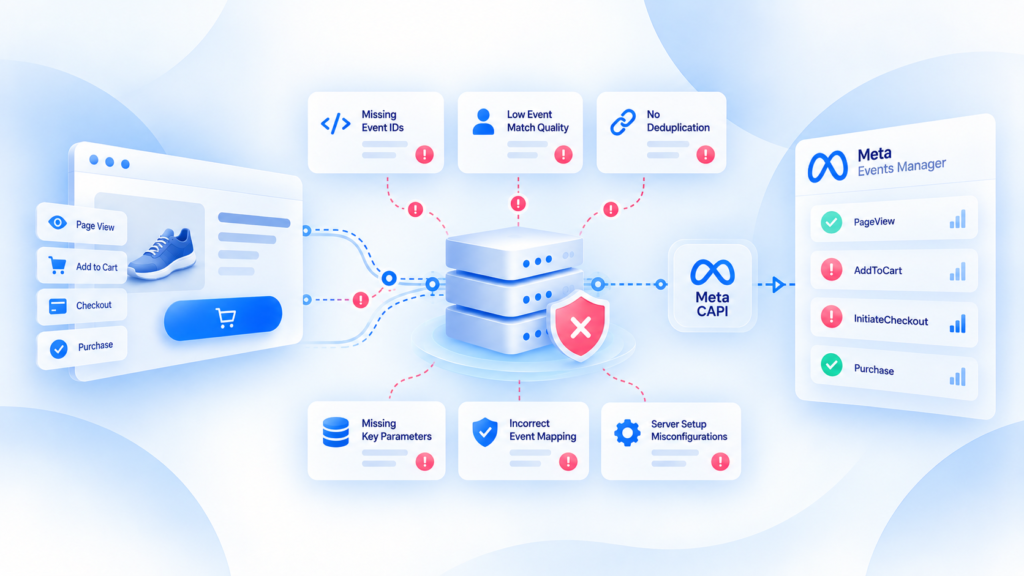
Common Meta CAPI setup mistakes usually come from event ownership, identity, deduplication, and validation—not from the API request alone.
A Conversions API connection can return successful requests while the measurement setup is still wrong. The practical question is not “is CAPI connected?” but “does one real business event become one accurate, traceable conversion signal without duplication?”
Mistake 1: sending the same Purchase twice without one event identity
The most damaging CAPI problem is often duplicate ownership.
A store can send Purchase from a browser pixel, a native integration, Google Tag Manager, a plugin, and a server workflow at the same time. If two paths describe the same order but use unrelated event identities, the destination may not recognize them as copies of one logical conversion.
For every Purchase implementation, document:
- which systems can send Purchase;
- whether browser and server paths overlap;
- which stable identifier represents the logical event;
- whether a retry reuses the same identity;
- whether a thank-you-page reload can create another Purchase.
If duplicate Purchase events are the main symptom, start with the dedicated Meta CAPI deduplication guide before changing the wider stack.
Mistake 2: confusing event IDs with order IDs
An order ID identifies the commerce transaction. An event ID identifies a logical measurement event.
They can be related, but they are not interchangeable concepts.
A good implementation makes the relationship explicit. For example, one order may produce a Purchase event whose event identity remains stable across browser and server delivery. The order ID can still be retained separately for reconciliation with the store.
The important requirement is consistency. Generating a fresh event ID independently on each delivery path defeats the purpose of deduplication.
Mistake 3: treating Event Match Quality as proof that CAPI is healthy
Event Match Quality, event coverage, and deduplication answer different questions.
- Match quality: does the event contain useful permitted information for matching?
- Coverage: did the expected event arrive?
- Deduplication: did multiple delivery paths represent one conversion once?
- Value integrity: are revenue and currency correct?
- Attribution: how did the platform assign credit?
A stronger matching score does not prove duplicate control is correct. A perfectly deduplicated event can still contain poor customer information. A well-matched event can still have the wrong value.
If matching is the problem, use the Meta Event Match Quality diagnostic guide rather than trying to solve it with duplicate logic.
Mistake 4: sending incomplete or inconsistent customer information
Server delivery is useful only when the event payload is accurate and permitted.
Common quality problems include customer information being present on one event but missing on another, inconsistent formatting, losing click or browser context during checkout, or sending fields without a clear source.
Do not fabricate identifiers or add fields only to chase a platform score. The correct approach is to trace which information is genuinely available at the business event, apply the platform's current requirements, and keep privacy and consent rules in scope.
Mistake 5: using a successful API response as the only test
A network-level success does not prove the business event is correct.
For a real or controlled test order, verify the path end to end:
- Did the store create the expected transaction?
- Did the correct Purchase event exist?
- Were value and currency correct?
- Did browser and server copies use the intended event identity?
- Did the destination receive the event?
- Was the event accepted without a duplicate or payload diagnostic?
- Can the event be reconciled with the original order?
This is why production validation needs both platform diagnostics and store truth.
Mistake 6: letting several tools own the same event
Adding another plugin or integration can make a tracking problem worse when ownership is already unclear.
Create a simple event-owner map before adding anything:
| Event | Current sender | Browser path | Server path | Source of truth |
| — | — | — | — | — |
| Purchase | Document the actual owner | Yes/No | Yes/No | Store order |
| Lead | Document the actual owner | Yes/No | Yes/No | CRM/form/backend |
The goal is not to maximize the number of senders. The goal is to make each business event explainable.
Mistake 7: debugging attribution before raw event delivery
Store revenue and attributed revenue are different measurement layers.
Before investigating why Meta credits fewer or more conversions, confirm whether the raw Purchase event exists and whether it was duplicated. If raw event delivery is healthy, attribution windows and platform reporting rules may explain part of the difference.
The ecommerce conversion tracking checklist is useful when the symptom is a broader mismatch between store truth and advertising or analytics dashboards.
A safer CAPI QA sequence
A practical QA order is:
- define the business event;
- identify every sender;
- verify one stable logical event identity where paths overlap;
- confirm value and currency;
- inspect permitted matching information;
- test retries and reloads;
- confirm destination receipt;
- reconcile with real orders;
- review attribution only after raw event health is understood.
This sequence prevents teams from optimizing the wrong layer first.
When the setup needs a deeper diagnostic
If you cannot tell whether the problem is missing events, duplicate Purchase events, identifier loss, value mismatch, or attribution, a diagnostic review is more useful than adding another integration.
Request a Tracking Health Audit through KePixel contact to map current event ownership and the failure point before recommending a larger implementation. Current platform/source availability should be confirmed separately before any implementation commitment.
Frequently Asked Questions
Does a successful CAPI request mean the setup is correct?
No. It confirms delivery at one layer, not that the source event, values, identifiers, deduplication, or attribution are correct.
Should browser and server Purchase events use the same event identity?
When they represent the same logical Purchase and both are sent to a destination that supports deduplication, the implementation needs a consistent identity strategy so the two deliveries can be recognized as one conversion.
Is Event Match Quality the same as deduplication?
No. Match quality is about information used to match an event; deduplication is about preventing two deliveries of one logical event from being counted as separate conversions.
Should I add another CAPI plugin if purchases are missing?
Not before identifying the current event owner and failure point. Another sender can create duplicates without fixing the missing-event cause.
What should I test first?
Start with one real or controlled Purchase, trace it from the store to every sender and destination, and compare the event back to the source order.