
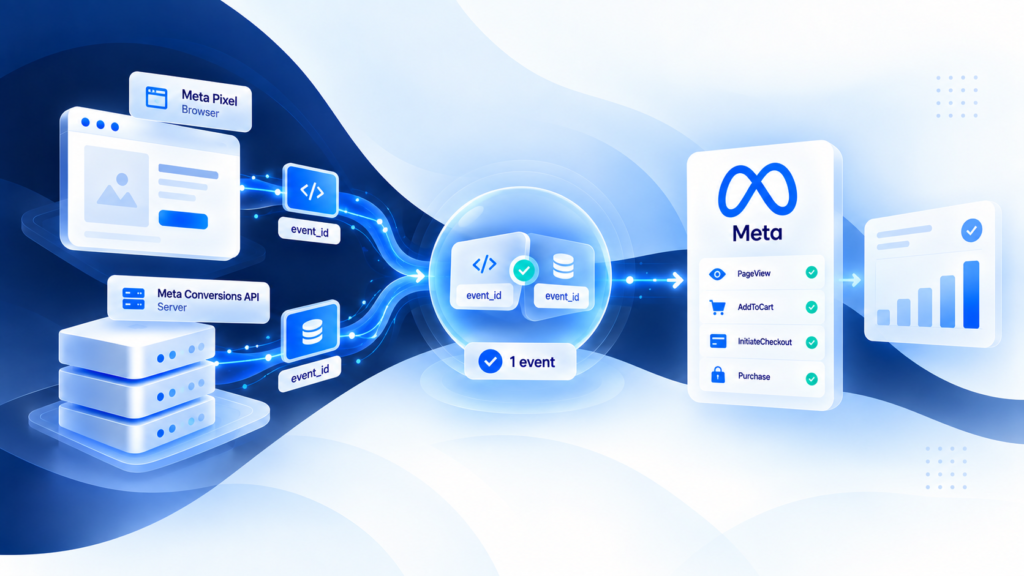
Meta Pixel vs Meta Conversions API is a comparison between two event-delivery paths, not a choice between “old tracking” and “better tracking.”
Pixel runs in the browser. Conversions API sends events through a server-side connection. Many measurement setups use both, but the combination only works well when the team defines event ownership and duplicate control.
What Meta Pixel is good at
Meta Pixel is close to browser activity.
It can observe and send web interactions such as page views, product interactions, and conversion events that occur in the browser. It also has access to browser context that a backend may not naturally know.
Its limitations come from the browser environment itself: scripts can fail, pages can change, consent state matters, identifiers can be lost, and several tools may compete to send the same event.
What Conversions API changes
Conversions API creates a server-side route for events sent to Meta.
The event can originate from a backend, commerce integration, server-side tagging setup, or another controlled measurement workflow.
The advantage is not that a server event is automatically “more accurate.” The advantage is that a server-side path can be easier to validate, monitor, retry, and reconcile when the source event is trustworthy.
Pixel and CAPI can describe the same Purchase
A hybrid setup often sends one logical Purchase through both browser and server paths.
That redundancy can improve delivery resilience, but it creates a duplicate-control requirement. The two deliveries need a consistent event-identity strategy so they can represent one business conversion rather than two unrelated Purchases.
If duplicate Purchase is already a symptom, read how Meta CAPI deduplication works.
Pixel vs CAPI by measurement job
| Measurement job | Pixel/browser path | CAPI/server path |
| — | — | — |
| Observe browser interactions | Strong fit | Depends on upstream collection |
| Send backend-confirmed business events | Limited unless surfaced to browser | Stronger fit when backend truth exists |
| Preserve browser/session context | Natural fit | Must be passed from a legitimate source |
| Centralize validation and delivery logs | Limited | Better fit in controlled infrastructure |
| Avoid duplicates automatically | No | No |
| Guarantee better attribution | No | No |
Neither path removes the need for correct source events, consent handling, values, identifiers, and diagnostics.
Do you need both?
Use both when there is a clear reason for redundant delivery and the implementation can control event identity.
A browser-only setup may be enough when critical events are reliable and the business does not need another operational layer.
A server path becomes more useful when:
- a trustworthy backend business event exists;
- browser-only delivery is measurably unreliable;
- several systems need one controlled event contract;
- you need stronger observability around delivery;
- you can operate the added infrastructure responsibly.
The right answer is based on the failure you are solving, not on a rule that every advertiser needs both.
Event Match Quality is not the Pixel-vs-CAPI decision
Match quality is one diagnostic layer.
A CAPI event can still have weak matching information. A Pixel event can have useful browser context. Adding another path does not automatically improve the quality of the data attached to the event.
If matching is the main problem, use the Meta Event Match Quality guide and keep it separate from duplicate diagnostics.
A practical comparison test
Take several real or controlled Purchases and answer:
- Did Pixel send Purchase?
- Did the server path send Purchase?
- Did both represent the same business order?
- Did they use the intended event identity?
- Was value and currency consistent?
- Did either path send more than once?
- Did Meta receive the events without duplicate or payload diagnostics?
- Can the result be reconciled to store truth?
That test tells you more than simply checking whether Pixel and CAPI are both “connected.”
If the comparison exposes a measurement problem
A Tracking Health Audit is the current verified diagnostic offer when the comparison exposes missing events, duplicate ownership, event-quality problems, or unexplained measurement gaps. This page is educational and does not state that Meta destination delivery is generally available in KePixel.
If you need to identify the broken layer before changing the stack, request a Tracking Health Audit. Current source and destination availability is confirmed separately before implementation.
Frequently Asked Questions
Is Conversions API a replacement for Meta Pixel?
Not automatically. Some setups use CAPI alongside Pixel; others may use a different architecture. The decision depends on event ownership and measurement needs.
Can Pixel and CAPI double-count the same Purchase?
Yes, if both send the same business event without an effective deduplication strategy.
Is a server event always more accurate than a browser event?
No. Accuracy depends on the source event, values, identifiers, mapping, consent, and implementation quality.
Does using both paths guarantee better attribution?
No. Redundant delivery can improve event coverage, but attribution still depends on platform rules and the quality of the underlying data.
What should I check before enabling both?
Map every Purchase sender, define one logical event identity, test reloads and retries, and reconcile the received events with real orders.